
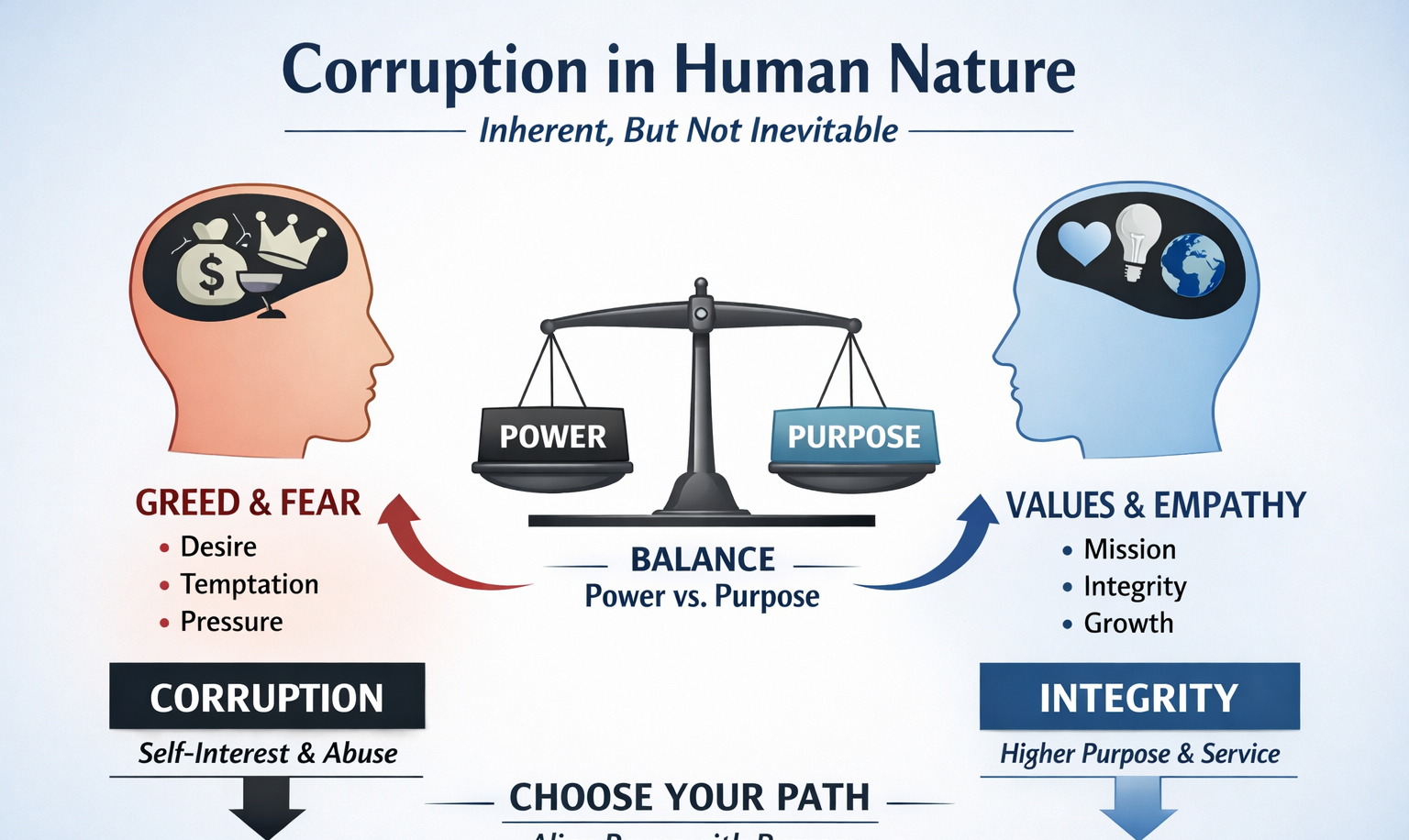
Corruption is anchored in a desire to win and benefit.
Driven by a very basic and very human inclination towards reward: to feel good, have goods and be in a good place – of abundance, status, luxury and power.
It all comes down to having a need to be secure and feel worthy and happy.
Corruption and bribery are just very misdirected and misused behaviours to achieve those underlying basic human needs, blown out of proportion – driven by greed and also by fear and crisis!
What is important to understand – and what behavioural science clearly shows – is that corruption is rarely a conscious decision to “be bad”. Research on Bounded Ethicality and Athical Fading in Negotiations (Mckenzie, Tenbrunsel and Bazerman) demonstrates that people systematically overlook the ethical dimension of their decisions under pressure, incentives or group dynamics.
This means: most people involved in corruption still perceive themselves as good and justified, deploying ethical blindness and bias.
Corruption also rarely starts big. As Dan Ariely’s research shows, people tend to cheat “just a little”, to an extent to still feel like a good person. But once the line is crossed one small misconduct after another, limits stretch, the threshold of what’s allowed and appropriate shifts – and behaviour escalates.
Fear plays just as important a role as greed. Under pressure, uncertainty or perceived scarcity, people are significantly more likely to justify unethical behaviour as necessary. We have sadly learned not so long ago – during the biggest health crisis of our time – that fraud and predatory behaviour with appetite towards large public deals exploded everywhere.
And then there is power. Research shows that power itself changes behaviour – it reduces empathy, increases risk-taking and creates a sense of moral entitlement. The higher the position, the greater the risk of losing perspective. However, power does not corrupt every person equally. As Scott Barry Kaufman explores in his article inspired by the Stanford prison experiment, individuals who scored higher on tests of aggressiveness, authoritarianism, narcissism, and social dominance, and lower on measures of empathy and altruism, are going to be crueller and more corrupt when in position of power.
Interestingly, power is not only psychologically transformative – it is also socially and even biologically attractive. Research such as “Is Power Sexy?” shows that status and power significantly increase perceived attractiveness and desirability. This creates an additional layer of reinforcement: power does not only give access to resources, but also to admiration, influence and social validation.
Corruption is therefore not an anomaly. It is a predictable outcome of how humans respond to incentives, power, fear and social norms.
Therefore, we can make sense in requirements of many legislations around the World that people in power, such as ministers, members of parliament and other public officials, CEOs and other executives in financial industry and similar – have to disclose their wealth before, during and after their mandate, and to be evaluated for personal adequacy and screened for reputation.
As argued above, we should also put much more effort into examining the MOTIVES of WHY someone is running for a position of power and high influence.
Behavioural science would suggest that intentions matter – but systems matter even more. Incentives, enforced accountability and transparency shape behaviour more strongly than declared values.
We can all think about great politicians, corporate leaders and entrepreneurs, who clearly were higher purpose driven. Who followed a mission to help others, find solutions and take initiative for progress of entire society.
These are leaders such as Nelson Mandela, who chose reconciliation over revenge. Or a new-age politician Jacinda Ardern, New Zealand’s 40th prime minister, who became globally prominent for an empathetic, communication-driven style of leadership.
In business, we see similarly positive examples. Paul Polman led Unilever with a long-term sustainability vision, resisting short-term profit pressure. Yvon Chouinard built Patagonia on environmental responsibility rather than wealth accumulation. Tim Cook, soon after assuming CEO position at Apple, started to prioritize and be vocal about sustainability over certain shareholders’ demands to do only what benefits the bottom line.
These were not passive or “soft” leaders. They were driven, determined and influential – but anchored in purpose beyond themselves and most importantly – they enjoyed high level of trust and genuine personal admiration and fellowship by masses.
Behavioural science supports this distinction. Power does not corrupt everyone equally. It amplifies who the person already is.
Research show that people with pro-social goals and with “communal relationship orientation” opposed to “exchange-transactional relationship orientation”, will put position of power to an amazingly beneficial and humanitarian use. They tend to become more generous and responsible when given power, while those with self-serving tendencies are more likely to express them more strongly.
Unfortunately, we can think of many persons of power, who demonstrate their primary interest for status and self-benefit. These leaders might spend first days in office focusing on acquiring luxurious company or government car, attending many VIP events, getting personally involved in large government procurement processes, putting their friends, family and ‘debtors’ to certain positions and in business, or even finding themselves much younger super-model looking new spouse… These should all be red-flegs indicating personality that might resort to corruption more likely, when given power.
Autocrats however are mostly driven by establishing and forever preserving total power and control. It’s another level of corruption.
How to recognizes? These leaders will heavily focus on using any and all means to eliminate contrarian ideas, weaken checks and balances institutions and discredit democracy watchdogs (like NGOs and investigative journalists).
Social norm theory explains that fear and control eventually become normalized, people adapt accordingly, silence themselves and close up – even when they internally disagree. So, autocrats regularly demonstrate their power and cruelty, as reminders to be and stay afraid.
Self-interest of any kind of leader needs to be financed. For this, they will resort to various kinds of corrupt behaviour – asking and receiving bribes, bribing others, trading with influence and privileged information, obstructing justice, resorting and enabling fraud and extortion, causing huge losses and harm to society.
All to secure personal benefits and not what they are supposed to do – to serve the public, take care of balanced stakeholders’ best interests and foster growth and development of organizations, economy, society and a country.
If you are a person of influence who means well, you must know the following.
Not everyone around you shares these intentions. So, you must not assume good intentions in others based on your personal beliefs, but value-check your team members and those who approach you with ideas, products and services.
You will for sure be targeted by other people’s interests regarding your power and influence. So, keep within your circle of trust and have others from the outside earn it over time.
Assume that people will try to find ways to you and sometimes they will try to sell the access to you, as well as confidential information.
Remember: only people who can betray your trust are those whom you trust.
The difference between corrupt and purpose-driven leaders is not intelligence, ambition, or even intensity. It is the alignment between power and purpose — and the systems they build around themselves to stay accountable.
References
- Bazerman, M. & Tenbrunsel, A. – Blind Spots
- Ariely, D. – The Honest Truth About Dishonesty
- Keltner, D. – The Power Paradox
- Merritt, Effron & Monin – Moral licensing research
- Mullainathan, S. & Shafir, E. – Scarcity
- “Is Power Sexy?” – American Journal of Sociology
- Greater Good Science Center – Does Power Corrupt Everyone Equally?

Copyright © 2026 Andrijana Bergant. All rights reserved.
Permission is granted to use, distribute, and reproduce this article in any medium, provided the source is properly cited and a link to the original article is included. Unauthorized use or duplication without proper citation is prohibited.
